Mongo Gill – 16th June 2013

Mongo Gill    Present – Elaine, John G, Jason

This was the third attempt on Mongo Gill in the past year or so.  The first time I’d been unable to whip up enough interest, and solo trips were frowned on by the publicity-conscious proprietors of Stump Cross on whose land it is.  The second time was snowed off – and probably the entrance would have been under thick drifts even had it been possible to get there.

So, third-time lucky…  I’d armed myself with a print-out from the excellent Braemoor website which turned out not to be strictly necessary, as Elaine’s guest was the author of the guide and knew the cave well.  But he insisted on me leading, which was a little like taking a driving test!

Richard (the owner) supplied us with a hammer, which we’d need to persuade the lock to open after an unsuccessful attempt had been made to break into the cave recently.  (It’s quite bewildering why someone would go to that much trouble to pirate the cave, but nowt so queer as folk…)


We first rigged Shockle shaft as Elaine planned to exit that way, then walked on a little further to North shaft, which we rigged in full.  There’s a couple of bolts outside the concrete entrance to rig a Y-hang from and an in-situ cord to act as a deviation for a free hang.  A drop of about 7m brings you to a ledge, with a rebelay for the final 4m which is optional as it’s not hard to climb.  At this point, it’s wise to take off SRT gear as plenty of crawling follows, and it won’t be needed if returning via the same exit.


The route is well described by the guide and isn’t hard to find, although at one point I was tempted to take a left turn too early but even if John hadn’t corrected me, it only went to a blind pit, so it would soon have been obvious.  The going is mainly crawling, interspersed with walking and stooping, and fairly level with nothing that could be described as ‘tight’.  There are still many fine formations, including some nice helictites
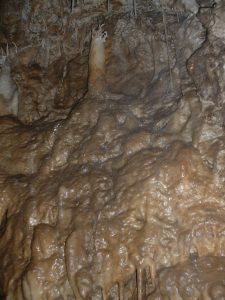
although it’s clear there must have been many more originally.  Apparently squaddies are sometimes sent through here on training exercises, which can’t help!


After about 30 minutes of this, a chamber called East Hade is reached.  A low crawl follows through what might be a duck in wet weather, but was little more than a big puddle.  This was either cool and refreshing, or horrendously unpleasant, depending on your point of view (really, you’d expect divers to be more water-tolerant!).  After this, progress tends to be more upright and includes some mined sections with dry-stone walling held in place by blackened timbers over a hundred years old, which call for some caution.  You can also see the remains of odd bits of mining equipment here and there.


We didn’t fully explore the lower reaches of the cave, but stopped near the point where the connection to Stump Cross is blocked by a collapse.  Richard suggested later this collapse might have been encouraged by the previous (security-conscious) owner, but it’s fair to say it’s unstable anyway.  Returning via a slightly different route, there is a greasy climb aided in part by an iron ladder.  As Elaine was having difficulty reaching a handhold off the top of this, I ‘gallantly’ turned round to lend a hand.  Having done so, I found my own grip failing so I slowly slid back down on top of her but pointing the other way.  After a short but hilarious session of 3D Twister, we proceeded in a more orderly fashion.


Elaine took a short detour to reach the Shockle Shaft exit (the guide’s description of having to swim through liquid clay is exaggerated) and I followed John out. Despite his claim to be a pensioner, it was all I could do to keep up with him, and the duck was really quite welcome to cool off when it came.  At this rate, it didn’t take too long to exit, and we got back in time for afternoon tea at the Stump Cross Café.


Although Mongo Gill is not a huge system, there’s plenty of interest and I didn’t feel I’d exhausted its possibilities at all.  Even though it’s a long journey for those not fortunate enough to live in God’s own county, it would well repay the effort!
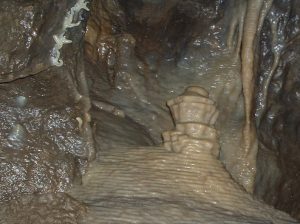
Roaring Hole – 13th March 2013

Roaring Hole   Ed, Sophie, Paul, Jason

I’d wanted to revisit Roaring after a previous attempt under Mr Gordon’s leadership two years ago only got as far as the 2nd boulder choke due to the volume of water cascading down it.

It was new to the others, and my memories of the route to the cave were hazy – perhaps because of the blizzard that had been blowing at the time.  Consequently our search for the entrance (in a “prominent shakehole west of Braithwaite Wife Hole – you can’t miss it”) took a good half-hour of quartering the limestone pavement on Ingleborough.  (For future reference, turn off the path to the right only about 50m after the sharp right-hand turn in the path as it starts to pass BWH on the left).

Down the entrance climb/slither,  then the first ‘boulder’ choke (more of a scaffold choke) and the giant’s staircase made of rubble cemented into retaining walls – pausing only to wonder at the engineering effort that had gone into it all.  Ed rigged the first pitch, all the way to the top of the second boulder choke.  I skipped the second half of the abseil, not wanting to miss the airy tiptoe round the Bandstand.  The choke was much drier than previously, but what water there was magically found its way down the backs of our necks.  A short crawl followed, then another hole in the floor leading to another boulder choke apparently named after Morecambe Pier – again generously scaffolded.

This led to another chamber, where we had been warned by Helen of a ‘committing’ vertical squeeze.  Coming from such a hardened explorer, this caused some nervous anticipation – so the consensus was that Sophie should try it first (the slimmest, and least argumentative?)  She did so, having removed her SRT kit, so I followed.  It was snug, but the drop far from abyssal – by exhaling slowly, one slides down a couple of feet to a gentle landing below.  Paul pronounced his physique too manly for the attempt, so Ed came next but pronounced it ‘uncomfortable’, so retreated (a radical idea that – that caving should be comfortable !)  Sophie and I continued down a short walking passage and a climb down into Slab Chamber.  Here there is a near-vertical slope onwards and downwards.  It looks intimidating at first, but on closer examination it’s well-provided with handholds and makes for an entertaining climb.

At this point, Sophie generously left me to it, and returned to Ed and Paul.  True to form, at the bottom of the climb, there is another hole in the floor and another boulder choke leading to a streamway which goes on to the Rift with a pitch to the bottom.  However, I turned round at this point in case the others had tired of waiting.

The return journey to the Bandstand is easy, if more strenuous than before.  As I was still not kitted-up for SRT, I was tempted to investigate the in-situ bit of looped tat that adorned the first part of the pitch.  Together with a metal bracket someone had helpfully bolted to the rock, it is possible to haul oneself up the start of the pitch, after which free-climbing becomes eminently possible.  However, any feelings of achievement I might have had after that were dispelled when it came to getting up the beginning of the final climb out.  This involves a surprisingly awkward upward thrutch without the benefit of any kind of foothold.  Fortunately,  Ed’s knee, and a shove or two, provided the necessary impetus.

Apart from that, I thoroughly enjoyed Roaring Hole, a nice clean cave without being too aqueous, plenty of fun scrambling about and – I believe – can reasonably easily be done without ladders or SRT, which is always a bonus.

Lancaster Hole – 21st November 2012

Lancaster Hole – Andy G, Jason

A select team gathered for a trip with few ideas about where we should go.  I wanted to visit Slug World, so we turned left at the bottom of the entrance pitch (breaking the habits of a lifetime).  The muddy climb quickly degenerates to a muddy crawl, but very soon pops out into a decent passage with some fine formations.  A bit of a squeeze leads into another chamber with some even better stal.  This is emphatically taped-off so we turned around.  The next time you’re waiting at the bottom of the pitch for 5 people to ascend, it’s well worth a ten-minute detour.

Andy expressed an interest in visiting the Graveyard, and as he’d been kind enough to bring a suitable rope for the pitch, it seemed churlish to demur.  Now where was the entrance ?  I tried a turning off Bridge Hall – a high rift, not what we were looking for, but it went on – might as well have a look…  We realised it was the Sand Caverns, a series of, well, caverns linked by some fun climbs and slides.  These went for some time until I came to a tight crawl leading to a low bedding chamber.  All I could remember from the description was that Sand Caverns had some ‘very tight’ connections elsewhere (the Crater) , which neither of us relished, so we headed back.

A few metres further down Bridge Hall was the Graveyard entrance.  A short crawl, the little pitch, then into the Graveyard.  I’d forgotten how well-decorated this is.  But the route Andy was after was down the big trench in the floor.  This looked impossible to climb down, until he pointed out the concealed rope at the right-hand end. This leads onto a narrow streamway.  Following this downstream, a crawl off to the right leads into the Stump Cavern Extensions (the earlier passage to the right, up a greasy climb does not go anywhere).  This turned out to be a series of protracted crawls, flat-out, but not uncomfortable.  However, he was not totally sure of how this linked back to the Graveyard, and time was marching on, and the call of the Black Sheep was getting more insistent, so we turned round and retraced our drag marks.

Back in the stream, we paused for a little wallow to wash the worst of the mud from the SRT kits, then were soon back in Bridge Hall, and out – just in time for a swift one at the other Hall (Whoop).  A grand evening’s entertainment – I’d been to three places in Easegill for the first time, whilst leaving some more to do on another occasion: completing the Stump Caverns Extensions circuit and (maybe) the Sand Caverns to Crater link.

Cupcake to Committee Pot – 28th October 2012

The Cupcake – Committee Pot: Richard M, Tim D, Jason

I’d been looking forward to this trip: the combination of one of the newer discoveries in the Three Counties system, some nice pretties and a through trip was enticing.  But I knew my companions would take some keeping up with, they being well-known members of the species Homo Ferrous Troglodytes.

According to Richard’s informant, all ropes were in place except for the short entrance pitch, which was a bonus, so we were quickly at the bottom and able to see The Cupcake in all its glory

– along with many other pristine stal formations and a host of long straws.  Care has to be taken to avoid these on the next little pitch, and more fine formations follow.  The following pitch is aptly named “Mud” and is a portent of things to come, but the going is still easy although a generous coating of mud does nothing for one’s SRT kit.  Then there’s an upward pitch, short but made longer by having to wipe gobs of gloop off the rope at each prussik step.  The next section of passageway is reasonably roomy but requires great care to avoid breaking or clarting-up some more nice formations.  It’s hard not to see this section deteriorating with more visitors.

From here the trip showed its less agreeable side; crawls in sharp hardcore, then mud, then some tight bits before we came to Bendall’s Dilemma.  We had understood this to be a hard squeeze, but we passed it with only a little thrutching and cursing.  We were rewarded by emerging into the fine large chamber of Hubert Carstairs II.  Following on into Hubert Carstairs I,we were presented by a choice of ascending ropes.  Richard took the right-hand one and after some doubtful mutterings, Tim investigated that on the left.  I thought it important for someone to stay in the middle to relay messages (and avoid unnecessary climbing).  After a while, Richard located a third rope, much shorter than the other two, which was the way on.  There swiftly followed another short ascent in a rift.  Short, but tight and awkward, bloody awkward – at least to me.  Richard cheerfully said “you got your money’s worth out of that one!”

Not long afterwards is the “Inverse Superman”squeeze, a U-bend followed by a constriction with a lump of rock cunningly sited at chest level.  A curious balletic episode ensued.  Richard goes first, passing through like an eel.  Jason makes a feeble and unsuccessful attempt to remove his SRT kit, attempts the squeeze, jams his croll against the lump, retreats, advances, jams and retreats again.  Tim reaches over and manages to divest Jason of his harness.  Jason advances – and passes!  Two sets of SRT kit and a helmet are passed forward. Tim advances, jams and retreats twice, then calls for Richard to push from behind.  Jason lies down, Richard crawls back over him.  Somehow his mere presence encourages Tim to a final, successful push. Then Richard crawls over Tim and back through the squeeze to retrieve Tim’s descender which had parted company from him in the fun.

After that, I’d like to say it was all plain sailing.  I’d like to, but it was actually a long grim crawl.  Not without variety though; sideways thrutching, flat-out crawling in mud, flat-out crawling in water.  And all the way pushing a ball of tangled straps and mud that was the SRT kit.  Eventually – eventually – we reached the top of the pitches at the top of Count Lazlo Stroganoff’s Aven.  At least one could sit up, just, though I found untangling my kit and putting it on in that position took so long that by the time I got to the bottom Tim was considering mounting a rescue.  On the last couple of pitch sections, the noise of rushing water became more noticeable.  Could this be the Notts II streamway ?  It could – it was.  Hallelujah!

Richard had already headed out to derig, so we were faced with the quandary of which way to go.  Knowing the inlet (Sir Digby Spode’s) was between the exit and Curry Inlet, it should have been obvious to head downstream.  But by this time, I was beyond rational thought, so we headed upstream for a bit against quite a sporting current (which cleaned up the gear a bit at least) before Tim decided we’d gone wrong.  After rather more streamway than we’d been expecting, we found the familiar passage and headed out for the jumble of scaffolding, ladders and breeze blocks – and daylight.

I was quite surprised, having felt the trip to have gone so long I was expecting darkness, but it was only 4:15.

So, a trip I’d thoroughly recommend to anyone – as long as I don’t have to come with them!

PS – If, like me, you’ve wondered at the origins of the colourful names of the various inlets and chambers of Notts II, you can find some clues here: http://loveandliberty.blogspot.co.uk/2007/03/rogue-male-in-trap.html

Lost Johns – 22nd July 2012

Lost John’s (or Johns?  Or Johns’ ?) cave.  John F, Andy G, Tim D, Ken W, Jason

The advertised trip (Boxhead to Death’s Head exchange) had mysteriously failed to generate a quorum, so the decision was taken to do something less demanding.  Tim and Ken apparently had more important things to do in the afternoon, so Tim shot off to rig down to Centipede, the rest of us following in a more leisurely fashion.  Having got to the bottom of Centipede, he and Ken did a smart turn-round leaving the rest of us to proceed to the streamway.

This went straightforwardly enough, water levels being surprisingly low given the recent ‘Summer’, although Battleaxe traverse seemed to have even fewer footholds than usual.

Time was not pressing, so we had a look upstream (until it got too small) and downstream (until it got too wet).  John announced he wasn’t going further downstream than welly-depth, but manfully continued until the canal section – he obviously had his big wellies on!

There were a variety of inlets, and muddy ropes hanging from the roof, all of which doubtless went somewhere interesting, but no-one was keen enough to take up the challenge.

The return trip was also uneventful, though slower due to reduced portering manpower.  I tried to persuade Andy of the merits of pantins (I’m a recent convert), but after faffing for a few moments getting it off the rope at the head of Candle, I don’t think he was convinced.   Anyway, we made fair time and were rewarded with the smell of warm grass about 4:30.

White Scar – 8th July 2012

White Scar     Elaine, Clive, Gareth, Ed, Sophie, Jason


I was looking forward to this trip as I’d only seen it as part of a guided tour before, and at £2.50, it was a bargain compared with the public entrance fee!  So it was a relief that the recent weather hadn’t meant a cancellation, but alas, our leader Mr Gordon was indisposed, so the mantle fell to Elaine – at least as far as paying the entrance fee.

The first section presented no navigational difficulties – follow the concrete until just before the steps, then take the ‘dead end’ (to tourists) to the right, and hop over the barrier.  Very soon, we were in the 60’ lake – aptly, if unimaginatively named.  Some of it was navigable, just, by walking tip-toe, but we were able to use the thoughtfully-provided fat yellow traverse line for the deeper parts – until someone pointed out it was probably the lighting cable for the Battlefield Series.

Soon after comes ‘Big Bertha’, a rock wedged in the passage that is, well, big – then the boulder choke.  This gave some concern as a) we knew it was possible to go astray, b) the most recently anyone had been here was 10 years ago and c) maybe the water levels were high enough to block the way?  Gareth intrepidly found a way through at (or slightly beneath) stream level – when asked how big the air-space in the duck was, he answered “it depends how big your nose is!”.  This wasn’t sounding promising.  Fortunately Sophie, who was next, was more sensible and found a perfectly dry wriggle through the boulders higher up.

After that, we soon found ourselves back in the spacious streamway, which continued on and on.  Entertainingly, the water depth is apt to vary without warning leading to the odd sudden plunge or barked shin on an unseen shelf.

At length we reached the start of the phreatic section – wide lowish passages mostly filled with water.  Once again, Gareth plunged ahead, with the rest of us following slightly less enthusiastically.  Actually it was quite fun when you got used to it – you could keep your head (if nothing else) out of the water – nearly all the time – and with the slight buoyancy of a wetsuit/neofleece, you could float through quite comfortably paddling away with your hands on the bottom.  Eventually (are we there yet?, are we there yet?) we reached the sump, which was fairly unremarkable, but at least we could say we’d made it.

On the way back, we had a quick climb up at the start of the vadose passage to see an alcove full of magnificent straws – easily two metres ! – well, big anyway.

Arriving back in the show cave, we sneaked up the steps to have a look at Battlefield Cavern between tours.  I was briefly tempted to nip down and relieve the ‘caver’ manikin of his Meander oversuit – what a waste! – but thought better of it.  On the way out it was gratifying to make our way past a party of kids who looked suitably impressed.  Or was it horrified ?  Or disgusted ?

Anyway, it was a fine trip, and my oversuit hasn’t been as clean for a long time!

Lancaster Hole – 3rd November 2011

Lancs   Tim D, Jason

The trip was billed as Lancs to Wretched Rabbit, which I was keen to repeat, but Tim had other ideas, and he was leading.  No complaints though, we had a great trip, and I felt I’d added a couple of pieces to my mental jigsaw map of Easegill.

We went down Fall Pot as usual, splashed upstream (fairly wet, not too bad) to Oxbow corner.  The rope that marked the climb up was still there, but you could see a fridge-sized rock which must have moved recently – pinning the rope and blocking the way on.  We didn’t make a close inspection in case it decided to move again.  So we went through the boulder choke.  And it turned out to be easy.  My mistake previously was to try to climb up through the boulders, as is only natural.  If instead you keep almost entirely to the stream, and keep right where there’s a choice, then pop up to the left when the stream starts to look desperate, you’re through in about 5 minutes.  Then you climb up – back on yourself over the top of the boulders.

So, instead of exiting at WR, we turned back on the high-level route, with many attractions I’d forgotten: Painter’s Palette, fine stalactites and black-and-white striped curtains (how do they form?).  Scylla and Charybdis now boast traverse lines, which slightly spoil the fun, on the other hand the recent wet weather had left a thin film of condensation over the mud, making it very slippy, so it was probably a good thing.

In fact, much of our progress was marked by variations on “Whoops…” – thud! as one or the other lost traction.

Progressing onto Stake Pot we passed the route to Cape Kennedy on the left (another day, perhaps ?) then up and along to the top of Fall Pot again.

A great trip – and remarkably efficient; we were underground only a little over two hours.  The early finish was just as well, as I had two significant diversions due to roadworks to contend with on the way home!

Gavel Pot – 31st August 2011

Gavel   John, Miranda, Tim D, Jason

The trip was billed as ‘Gavel/Short Drop’, but instead of doing the usual exchange, we split into two parties.  Chris H, in his role as recruitment officer wanted an undemanding trip for two prospective members, so took them down Short Drop.

The rest of us also had different agendas.  Miranda, John and Tim wanted to take advantage of the relatively dry conditions to get to the bottom of Gavel.  I fancied getting some photos of Glasfurd’s chamber, not having been there before.

Tim rigged the entrance pitch at the eyehole to the left of the shakehole.  Crossing the bottom of the shakehole, the second pitch (also quite short) is reached, followed by a climb down a partly engineered shaft.  The guide books recommend a rope for this, but I’m no great climber and certainly didn’t need one.  We all went to the head of the third pitch, which looked a little acrobatic on take-off, so I was happy to turn back to the last right-angled bend in the passage to climb up towards Glasfurd’s.

I’d been told it was a bit tight, but the first constriction was positively roomy.  What’s the problem ?  But as you go on, it’s a series of fabulous chambers and ever-snugger connections, so I had to admit it was no place for the stout.  The decorations are first-class though – well worth a bit of a thrutch to visit, and in good condition for a popular spot.

I spent some time faffing about taking pictures.  The advantage of being solo is that no-one is kept waiting thereby, but I realised the photos lacked something of human interest.           

After that I was surprised to find John only just starting the ascent of the third pitch – it seems it had been an awkward rig, but we’d all got to do what we wanted – I certainly enjoyed it. The only downside being the somewhat late exit meant the local brewing industry went without our support.


Manchester Hole – Goyden Pot – 3rd July 2011

 Manchester Hole – Goyden Pot       Chris H, Jason

I’d been keen to have a club trip to Goyden for a while as it’s relatively close to me in Harrogate.  So much so, that I’d been on a route-finding trip with my daughter Rosa at Easter.  We followed the route at http://www.braemoor.co.uk/caving/route17.shtml – although any number of variations are possible, this being a fairly complex system, Braemoor’s route is a good tour of much of the cave with plenty of interest and variety.

So, it would have been nice to have had a better turnout, but at least Chris came so I could see how much of the route I could remember.  It was a fine day, with low water and no rain forecast, so we entered Manchester Hole cheerfully.  There’s not a lot to this and we soon found ourselves facing the forbidding ‘false sump’, which you ignore and take a sharp right into an uninviting duck (not too bad at all in these conditions).  Passing by the dive line of the real sump, you come to the beginning of the connection to Goyden dug out by the Black Sheep Diggers from the other end.  This is an entertaining mix of bedding plane crawls, wet boulder chokes and at one point, so Chris informed me, a squeeze.

Before too long, we emerged into the impressive main streamway of Goyden, from where Braemoor takes you on a romp around the system.  The caving is very varied, a lot of walking, some crawling, a little canal section and a surprisingly awkward 4-foot climb!  There’s no SRT required, though there is a 20-foot climb provided with a bit of knotted tat when we were there (it was removed soon after as being ‘too dodgy’ !).  There’s little in the way of calcite formations, though there is a lot of chert, often bulging out of walls in bands, giving the appearance of bin liners stuffed into crevices.

We came eventually to the main entrance of Goyden,  where Chris took some nice photos, we spent a few moments in the warm sunshine before somewhat reluctantly turning back to take the quick route back to the streamway and out via Gaskell’s passage to Church Pot.  Before we exited, we decided to have a look at Sump 2.  It turns out that you get there via Pinnacle Climb, which is partially roped, but the bit that isn’t looked highly exposed, with a tight passage at the top, so we wimped out and turned back for Church Pot.  On the way, Chris decided to investigate to investigate a narrow, grotty little dig, I’m not sure why…

Shortly after, we found the right way out, which is hinted at by several excellent fixed ladders taking you up the rift – but not all the way, the final few meters is a sweaty vertical thrutch which emerges from a capped concrete pipe in the bed of the Nidd (which was completely dry here).

So – 3 hours or so of fine and varied caving – much to be recommended!

Dismal Hill to Old Ing – 18th May 2011

Dismal Hill      Chris H, Andy G, Jason

A skeleton crew of three tackled Dismal Hill – obviously the rest of the club had done it before!
In fact, they missed a fine trip; not long, but full of variety and interest.
The entrance is tucked away in a hollow just to the left of the path from High Birkwith.  A brief crawl led to a couple of nice climbs.  Turning left, I knew I was looking for a tight bedding plane, and quickly found one about 8” high with 6” of water.  If this was the way on, it was to a short trip indeed!

Fortunately, Andy had turned right along a short passage well supplied with sheep bones and found a slightly more spacious bedding plane, which he was kind enough to let me investigate.  It started off tight and continued that way for what felt like a long time (probably about 50m!) until it emerged – much to my relief – in a nice decorated streamway.
Turning downstream, a narrow but pleasant passage goes for about 150m, getting deeper until you have to swim if you want to get to the sump.  We declined.

Upstream also gets deeper, but a thoughtfully-provided traverse line allows you to stay dry – at least above waist-level.  The scum on the wall showed the water level had recently been much higher still.
A climb up leads to another crawl, soon emerging at an impressive waterfall – we were now in the sump bypass part of Old Ing.  An exciting climb up the waterfall (fortunately roped) led to some more damp passageway.  A little before another sump, there’s a climb up to yet another flat-out crawl (Mick’s End) that showed signs of having been blasted out – ie lots of sharp rubble to inch over.  At least it was fairly short.
This emerged in the roof of the main Old Ing streamway via a particularly tight bit, which Andy’s manly chest proved too much for.  A pity, because the exit was only a short upstream stroll away…

After establishing that the squeeze really wasn’t in Andy’s size, he engaged reverse gear to come out the way we’d come in, followed by me, while Chris went out of Old Ing to fetch a ladder to save us the trouble of at least one of the crawls.

Meanwhile, Andy and I positively raced along – it’s amazing how much time you save by knowing where you’re going and not trying to stay dry! – and decided not to hang around for Chris in the streamway.  Again, we made good time to the exit, but not quite soon enough to stop Chris rigging the ladder in the ‘new’ entrance and descending to the streamway!  Never mind, at least he clocked up 3 different entrances to the system …  And he did find out where the ‘new’ pitch comes out – just before the traverse line in the upstream end of the passage, so now you know…